Collection: Stand Assist Lifts

Safe Sit-to-Stand Patient Transfers with Active Patient Participation

Stand assist lifts, also called sit-to-stand lifts, provide a safe transfer solution for patients who retain some weight-bearing ability but need assistance standing and moving between seated surfaces. Our collection from BestCare and Hoyer includes models with weight capacities from 400 to 600 pounds, designed for both home care and facility use.

Skip to Product List →

Stand Assist vs. Full-Body Lifts: What's the Difference?

Understanding which type of lift you need is critical for safety and effectiveness:

Stand Assist Lifts Are For:

  • Patients who can bear some weight on their legs
  • Individuals who can follow instructions and participate in transfers
  • People who need help standing up but can maintain standing position briefly
  • Patients with upper body strength to hold onto lift handles
  • Those transitioning between seated surfaces (wheelchair to toilet, chair to chair)

Full-Body Lifts Are For:

  • Patients with no weight-bearing ability
  • Individuals who cannot participate in transfers
  • Completely bed-bound patients
  • Transfers requiring full body support with slings

Key Distinction: Stand assist lifts require active patient participation. The patient must be able to push up with their legs while the lift provides support and assistance. If the patient cannot bear any weight, a full-body patient lift is required instead.

How Stand Assist Lifts Work

Stand assist lifts use a combination of support features to help patients transition from sitting to standing:

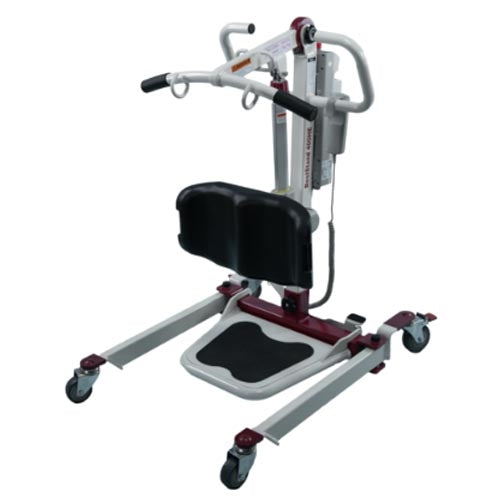
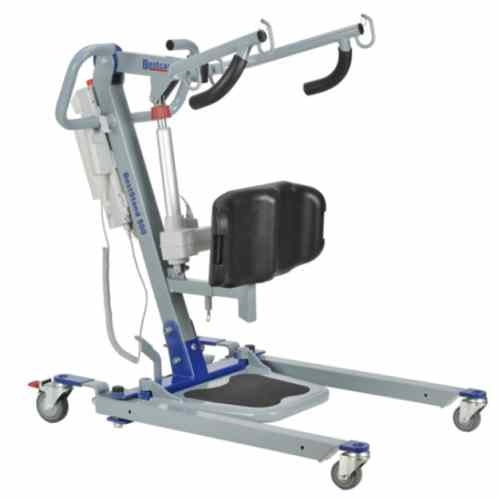
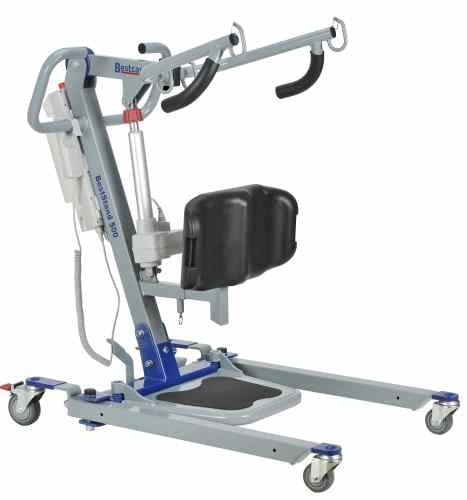
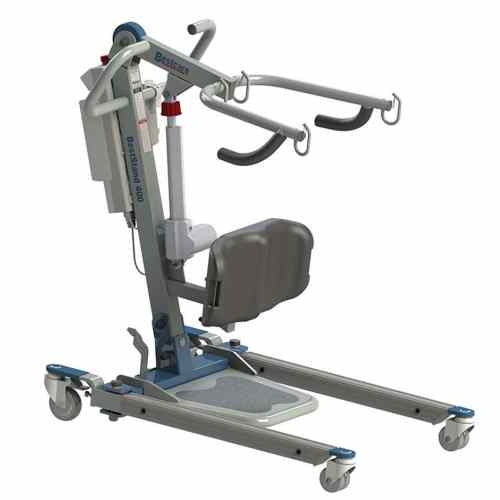
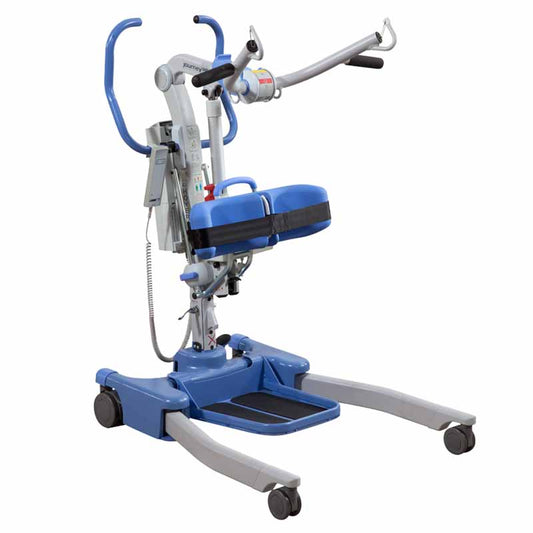
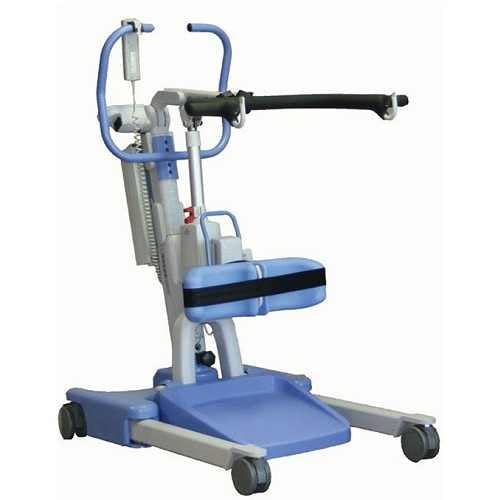
  1. Knee Pad Support: Padded knee support prevents legs from buckling and provides stability during standing
  2. Grab Handles: Ergonomic handles allow patients to pull themselves up while the lift assists
  3. Chest/Torso Support: Padded support panel stabilizes upper body during transfer
  4. Electric Lifting: Battery-powered actuator gently raises patient from seated to standing position
  5. Compact Base: Narrow footprint allows positioning close to wheelchairs, toilets, and chairs

The patient places their feet on the footplate, knees against the pad, and grasps the handles. As the lift raises, the patient assists by pushing with their legs while the lift provides the additional support needed to safely achieve standing position.

Key Benefits of Stand Assist Lifts

Encourages Patient Independence

Active participation in transfers helps maintain muscle strength, promotes mobility, and preserves dignity. Patients feel more in control of the transfer process compared to passive lifting with full-body lifts.

Reduces Caregiver Injury Risk

Eliminates manual lifting and reduces physical strain on caregivers. Stand assist lifts prevent back injuries common with manual transfer techniques and allow a single caregiver to safely assist larger patients.

Compact Design for Tight Spaces

Narrow bases (typically 20-24 inches wide) navigate easily through doorways, hallways, and bathrooms. The vertical lift design requires minimal floor space compared to full-body lifts with extended booms.

Quick, Efficient Transfers

Stand assist lifts complete transfers faster than full-body lifts. The simplified process of standing, pivoting, and sitting reduces transfer time and allows more efficient care delivery.

Versatile Transfer Applications

Perfect for multiple daily transfer scenarios including wheelchair to toilet, chair to wheelchair, wheelchair to shower chair, bed edge to wheelchair, and car seat to wheelchair.

Common Transfer Scenarios

Toilet Transfers

The compact base fits over most standard toilets, making bathroom transfers safer and easier. Patients can stand, pivot, and sit without complicated maneuvering. This application is particularly valuable for maintaining bathroom independence and dignity.

Wheelchair Transfers

Moving between wheelchairs and other seating is simplified. The lift positions close to the wheelchair, assists the patient to standing, allows pivoting, and lowers them safely onto the destination seat.

Rehabilitation and Physical Therapy

Some models feature removable footplates, allowing patients to practice standing and taking small steps while supported by the lift. This gait training capability supports rehabilitation goals.

Bed-to-Chair Transfers

For patients who can sit at the edge of the bed, stand assist lifts provide the support needed to stand and transfer to a nearby wheelchair or chair.

Types of Stand Assist Lifts

Compact Stand Assist Lifts (400 lb capacity)

Smaller, more maneuverable models ideal for home bathrooms and tight spaces. Models like the BestCare SA182 and SA400H offer exceptional maneuverability with shorter wheelbases and narrower profiles. Perfect for residential settings where space is limited.

Standard Stand Assist Lifts (400-500 lb capacity)

Full-featured lifts balancing capacity and maneuverability. The BestCare Stella SA400 and SA500 provide robust construction, extensive height adjustment, and comfortable padding for daily use in both home and facility settings.

Bariatric Stand Assist Lifts (600 lb capacity)

Heavy-duty construction with reinforced frames and wider support surfaces. The Stella SA600 accommodates larger patients safely while maintaining the compact footprint essential for bathroom access.

Premium Stand Assist Lifts (440-600 lb capacity)

Advanced features including powered base adjustment, extended lift ranges, and superior build quality. Hoyer models like the Journey and Elevate offer institutional-grade construction and advanced positioning capabilities for demanding facility environments.

Essential Features to Consider

Weight Capacity

Select a lift rated for at least 50-75 pounds above the patient's weight. This safety margin ensures reliable operation and accommodates weight fluctuations.

Base Width and Clearance

Measure toilet clearances and doorway widths. Compact bases (20-22 inches) fit standard toilets, while wider bases provide additional stability for heavier patients.

Knee Pad Adjustment Range

Height-adjustable knee pads accommodate different patient heights. Look for at least 4-6 inches of adjustment to fit various users comfortably.

Lift Height Range

Sufficient lift range allows transfers between surfaces of different heights (low wheelchair to standard toilet, bed to chair, etc.). Most lifts offer 15-20 inches of vertical travel.

Handle Design

Ergonomic, padded handles at appropriate heights help patients pull themselves up. Some models offer adjustable handle positions to accommodate different patient needs.

Battery Life and Controls

Rechargeable battery systems provide 40-60+ lift cycles per charge. Hand pendant controls should be intuitive with large buttons for easy operation by caregivers.

Safety Features

  • Emergency Lowering: Manual release mechanisms allow safe lowering during power failure
  • Anti-Slip Footplates: Textured surfaces prevent feet from sliding during transfers
  • Padded Supports: Soft padding on knee pads and torso supports prevents pressure points
  • Locking Casters: Total-lock wheels prevent movement during transfers
  • Low Battery Alerts: Visual and audible warnings prevent mid-transfer power loss
  • Stabilizing Straps: Optional safety straps provide additional security for patients with balance concerns

Who Benefits from Stand Assist Lifts?

Stand assist lifts are ideal for patients with:

  • Limited Mobility: Arthritis, joint pain, or weakness that makes standing difficult but not impossible
  • Post-Surgery Recovery: Hip or knee replacement patients transitioning back to independent standing
  • Progressive Conditions: Early-stage Parkinson's, MS, or other conditions where some mobility remains
  • Obesity: Patients whose size makes standing difficult but who retain weight-bearing ability
  • General Weakness: Aging-related strength loss, deconditioning, or temporary weakness
  • Balance Issues: Individuals who can stand but need support to prevent falls

What's Included

Stand assist lifts typically include:

  • Complete stand assist lift with adjustable knee pad and support panel
  • Rechargeable battery pack (installed)
  • Battery charger
  • Hand pendant control
  • User manual and safety instructions
  • Most models include stabilizing straps

Maintenance and Care

Stand assist lifts require minimal maintenance. Keep battery charged between uses, regularly inspect knee pads and support panels for wear, clean surfaces with standard disinfectants, and check emergency lowering mechanism monthly. Battery packs typically last 2-3 years before requiring replacement.

Comparing Stand Assist Models

BestCare Stand Assist Lifts

Value-focused models offering reliable performance at competitive prices. The Stella series provides excellent features including TiMotion electronics, comfortable padding, and compact designs. Ideal for home care settings and facilities seeking cost-effective solutions.

Hoyer Stand Assist Lifts

Premium construction with advanced features including powered base adjustment, extended lift ranges, and institutional-grade durability. Journey and Elevate models offer exceptional build quality and comprehensive warranties for demanding facility use.

Choosing Between Stand Assist and Full-Body Lifts

Choose a Stand Assist Lift if: Patient can bear weight on legs, follows instructions, can grasp handles, needs assistance standing but can maintain position briefly, and transfers are primarily between seated surfaces.

Choose a Full-Body Lift if: Patient has no weight-bearing ability, cannot participate in transfers, requires complete support, needs floor-to-bed transfers, or has cognitive impairments preventing cooperation.

Consider Having Both if: Patient's condition fluctuates, multiple family members with different needs share equipment, or you want maximum flexibility for changing care requirements.

Warranty Coverage

Our stand assist lifts include manufacturer warranties:

  • 3 Years: Lift frames and structural components
  • 2 Years: Actuators, control boxes, pendants, and chargers
  • 1 Year: Battery packs and consumable components

Free Shipping & Expert Guidance

All stand assist lifts ship free within the continental United States. Most models ship within 1-2 business days. Our medical equipment specialists can help you determine if a stand assist lift is appropriate for your patient's needs, recommend the right capacity and features, and explain proper transfer techniques.

Call 800-998-4703 Monday through Friday, 7am-5pm EST to speak with a specialist.

Not sure if a stand assist lift is right for your situation? Our team can discuss your patient's specific abilities, weight-bearing capacity, transfer needs, and living environment to recommend the best lifting solution. We'll help you understand the differences between stand assist and full-body lifts and ensure you select equipment that's safe and appropriate for your circumstances.

parts:

Filter:

Brand
0 selected Reset
Availability
0 selected Reset
Price
The highest price is $5,838.00 Reset
$
$

7 products

Filter and sort

Filter and sort

7 products

Brand
Availability
Price

The highest price is $5,838.00

$
$

7 products